.png)

Showing posts with label Speech Therapy Blogs. Show all posts
Showing posts with label Speech Therapy Blogs. Show all posts
Thursday, August 25, 2022
How I Use a Mini-Visual Schedule for Push-In Speech Therapy


Sunday, August 7, 2022
My Favorite Preschool Songs for Following Directions
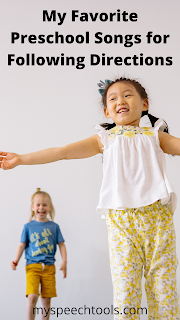
By age three, children begin to follow multi-step directions and work cooperatively with others, build social relationships, and take on roles in their family (picking up toys, putting on and taking off clothing items, etc.). Music provides the bridge between learning and fun. We know that children learn through hands-on experiences, and engage different parts of their brain through music. Music also provides the springboard for social-emotional and language development.
Monday, January 13, 2020
6 Picture Books About Winter Clothes for Speech Therapy
 Winter is here! that means cold days, comfy slippers, and warm blankets. Snuggle up with a good book and share your love of reading with your students. Read alouds and repeat readings with students are the perfect way to build background knowledge, share common experiences, target multiple objectives during speech therapy sessions, and spark a passion for reading. In this blog post, I want to share with you my top 6 favorite picture books about winter clothes. (Amazon affiliate links are included)
Tuesday, December 31, 2019
5 "Easy Does It" Practices at Work

As speech-language pathologists, we love to teach idioms to our students. Teaching figurative language such as: "It's raining cats and dogs," "hot off the press," and "feeling under the weather" are just a few of the common idioms we teach students. This year, I want to approach the new year with an "easy does it" attitude. What does "easy does it" mean? This idiom simply means, slow down, relax, and take it easy.
In this post, I want to suggest 5 "easy does it" practices you can apply in the workplace.
Thursday, December 26, 2019
How I Use "Lucky Ducks" in Speech Therapy

Who's the lucky duck in your classroom?
Parents, speech-language pathologists, and classroom teachers can target color and shape recognition, social skills, and critical thinking skills with the moveable memory game Lucky Ducks ™ (Amazon affiliate link) by Goliath Games U.S. This game is appropriate for children ages 3 and up and includes a motorized pond with 12 ducks. The game requires 2-AA batteries for the “pond” to rotate clockwise. Players choose which shape they want to look for (circle, square, triangle, star) and take turns picking a duck from the pond to see if it matches the shape they are looking for.
In this post, I want to share with you how I use Lucky Ducks™ in my speech therapy sessions, as well as ways to differentiate instruction to meet students' needs.
Friday, August 4, 2017
Part 4: Read the Nonverbal Communication

 (Part 4: Read the Nonverbal Communication)
 This is the fourth part of my series on Highly Effective Strategies for Managing Behavior. I encourage you to read the first three posts in the series, including:
 Part 1: Why is He Acting That Way?
Part 2: Create Routines
Part 3: Structure for Success
The previous posts in the series provide the background information to understanding the communication intent behind behaviors, the importance of routines, and tips and ideas for structuring the environment for success.
Friday, July 21, 2017
5 Reasons Why I Chose the Happy Planner PLUS a FREE Download

Are you looking for a new planner? What features do you look for? What type of layout do you like? How much do you want to spend on a planner?
During the summer, I take time to relax, binge watch a show on Netflix, and get inspired with new ideas for the upcoming school year. One important task I take on in the summer is finding my ideal planner for the next school year. I don't write much down during the summer so I tend to use my iPhone for planning the few appointments I have each week. So when I started looking at planners for the 2017-18 school year, I searched Pinterest and Amazon, watched You Tube videos, viewed online store products like Office Max and Wal Mart, and used Google search to figure out what would be the best choice for me. In this post, I want to share my new Create 365 Happy Planner with you, show you some of it's features and provide you with a few resources and ideas specifically for educators and speech-language pathologists.
Friday, July 7, 2017
4 Reasons You Should Follow Me on Bloglovin'

As a blogger and entrepreneur, I enjoy sharing my experiences, ideas, and resources with my customers, readers and followers. I have become part of a greater community of professionals. Bloglovin' offers easy access and organization of blogs and posts by subject or feeds.
Friday, May 19, 2017
Part 3: Highly Effective Strategies for Managing Behavior
 (Part 3: Structure for Success) This is the third part of my series on managing difficult
behaviors in language impaired children. I encourage you to read both the Introductory Post and Part 2: Create Routines for some background information in this series on managing
difficult behavior in your classroom or speech therapy room. In this post, I am want to outline 3 ways you can structure
your speech room for success.
(Part 3: Structure for Success) This is the third part of my series on managing difficult
behaviors in language impaired children. I encourage you to read both the Introductory Post and Part 2: Create Routines for some background information in this series on managing
difficult behavior in your classroom or speech therapy room. In this post, I am want to outline 3 ways you can structure
your speech room for success.
1. Eliminate Unnecessary Visual Stimuli
As much as I love colorful and stimulating classroom decor,
some of our special needs students just cannot handle the visual stimuli. In a
recent study by Carnegie Mellon University,
kindergarten students in brightly decorated classrooms were found to spend more
time off task and made less academic gains than those in
sparsely decorated classroom. For special needs students, systematic
structure, visual schedules, behavior charts and anchor charts for learning can
be useful decorations. Think about your speech room, is your classroom decor
structured for success? You can download my Wh-Question Anchor Charts FREEBIES HERE.
Sunday, April 23, 2017
Part 1: Highly Effective Stragegies for Managing Behavior

Then, I take a deep breath and remind myself that all I am seeing is BEHAVIOR, but the intended message is COMMUNICATION. That behavior IS communication, and my job is to help students reshape that behavior into an appropriate form of communication.
Wednesday, April 19, 2017
How to Adapt Books for Speech Therapy

One thing you should know about me is that I love to shop at thrift stores. I am not careless in buying just anything, but I do like to find some hidden treasures. That is where I find the BEST books to adapt for my therapy sessions.
Next time you drive by your local thrift store or Goodwill, turn around, go back, and check out their children’s book section. Most thrift stores in my area sell children’s books for 25 to 50 cents each. Hardback children’s books are typically 75 cents.
In this blog post, I'll share how I choose books to adapt, as well as the easy DIY steps you can follow to adapt your own books for speech therapy.
In this blog post, I'll share how I choose books to adapt, as well as the easy DIY steps you can follow to adapt your own books for speech therapy.
Monday, April 10, 2017
4 Simple Speech Therapy Games Using Plastic Eggs
 Do you need a motivating articulation activity that results in a high number of repetitions? Plastic eggs are enticing to children and only come out of our speech closet for one to two weeks out of the year. There are so many different ways to use plastic eggs in language therapy and play-based therapy. I want to give a few fun examples of how plastic eggs can be used in articulation therapy that results in up to 100 repetitions in a session.

Wednesday, April 5, 2017
Building Language with Free Play

Free Play is child-centered, and students choose the activity and direct the play. Free play elicits problem-solving skills, fosters social-emotional development, and allows for creative thinking to flourish.
Subscribe to:
Posts (Atom)